

Tyre Pressure Light On in Cold Weather? Why It Happens and What to Do
Quick answer: cold air is denser, so the air inside your tyres takes up less space and the pressure falls, by roughly 1 to 2 PSI for every 10°C drop in temperature. If your tyres were already a little low, the first frosty morning is enough to switch on the tyre pressure warning light. In most cases you just need to top them up to the correct pressure. If the light comes back within a few days, or it flashes, something else is going on.
Every year, as soon as the first proper cold snap arrives, drivers across the UK start their cars to find an amber horseshoe-shaped symbol glowing on the dashboard. It is one of the most common winter car worries, and it is usually one of the easiest to fix. This guide explains exactly why it happens, what to do about it, and how to tell a harmless cold-weather drop from a slow puncture or a faulty sensor.
Key takeaways
- Tyre pressure falls by about 1 to 2 PSI for every 10°C the temperature drops.
- A light that appears on a cold morning usually means your tyres need air, not that the system is broken.
- Always set pressures when the tyres are cold, using the figures in your handbook or on the door sill.
- A light that returns after topping up, or one that flashes, needs checking by a tyre technician.
- On cars first used from 1 January 2012, a TPMS fault is an MOT failure.
Why does tyre pressure drop in cold weather?
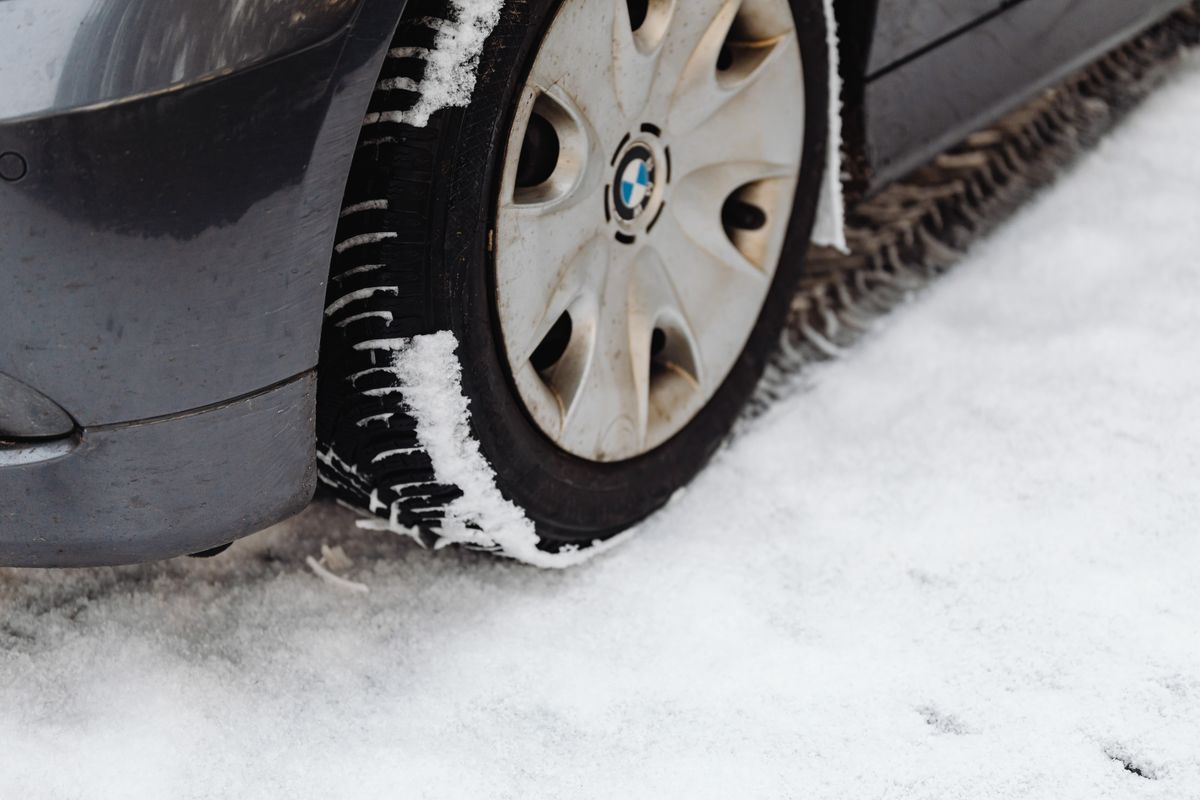
It comes down to basic physics. The air inside a tyre is a gas, and gases contract as they cool. The tyre itself stays the same size, so when the air inside contracts, it pushes less firmly against the tyre wall and the pressure reading goes down. Nothing has leaked out. The same amount of air is simply taking up less room.
The practical rule of thumb is a loss of roughly 1 to 2 PSI for every 10°C fall in air temperature. That may not sound like much, but think about when most people last checked their tyres. If you set them on a mild 20°C afternoon in September, a 0°C morning in November or December means they are sitting around 3 PSI lower before you have driven a single mile.
How much pressure will you lose? A worked example
The table below shows roughly what happens to a tyre that was correctly set to 32 PSI on a 20°C day. These are approximate figures based on the gas laws; your own readings will vary slightly.
| Outside temperature | Approximate tyre pressure | Pressure lost |
|---|---|---|
| 20°C (when set) | 32.0 PSI | None |
| 10°C | 30.4 PSI | About 1.6 PSI |
| 5°C | 29.6 PSI | About 2.4 PSI |
| 0°C | 28.8 PSI | About 3.2 PSI |
| -5°C | 28.0 PSI | About 4.0 PSI |
Now add the fact that tyres naturally lose a little air every month through the rubber and around the valve. A tyre that has not been checked since summer could easily be 5 or 6 PSI under by the first frost, and that is the point where the warning light steps in.
How the tyre pressure warning light (TPMS) works
The light is part of your car's Tyre Pressure Monitoring System, usually shortened to TPMS. It has been fitted to every new passenger car sold in the UK since November 2014, and many cars had it before then. There are two types, and knowing which one you have explains how the light behaves.
- Direct TPMS uses a small battery-powered sensor inside each wheel, normally built into the valve. It measures the actual pressure and often shows a reading for each tyre on the dashboard.
- Indirect TPMS has no pressure sensors at all. It uses the ABS wheel-speed sensors to spot a tyre that is rotating faster than the others, which is what an under-inflated tyre does. It needs to be reset after you adjust your pressures.
Both types are designed to warn you when a tyre falls significantly below its expected pressure, typically somewhere around 20 percent. That is why the system is best thought of as a last line of defence. As the tyre safety charity TyreSafe points out, TPMS is a critical warning system and not a replacement for checking your tyres with a gauge. You can read more about how the technology works in Pirelli's guide to TPMS.
Why does the light come on in the morning and go off later?
This is the classic cold-weather pattern, and it confuses a lot of drivers. Overnight, the temperature reaches its lowest point and so does your tyre pressure. You start the car, the system sees a low reading, and the light comes on.
Then you drive. The tyres flex, friction warms the air inside them, and the pressure rises by a couple of PSI. Combine that with the day warming up, and the reading climbs back above the warning threshold. On many cars the light then switches itself off.
The light going out does not mean the problem has gone away. Your tyres are still under-inflated for the conditions; they are simply sitting just above the trigger point. Treat a light that comes and goes as a clear reminder to check and top up all four tyres.
What to do when your tyre pressure light comes on
You do not need any special skills, and the whole job takes about five minutes at a petrol station.
- Slow down and find somewhere safe to stop. Walk round the car and look at each tyre. If one is visibly flat or bulging, do not carry on driving on it.
- Find your correct pressures. They are printed in the vehicle handbook and usually on a sticker inside the driver's door sill or the fuel filler flap. Front and rear figures are often different, and there may be a higher setting for a fully loaded car.
- Check the pressures when the tyres are cold. That means before a journey or after no more than a mile or two of driving. Warm tyres give a falsely high reading.
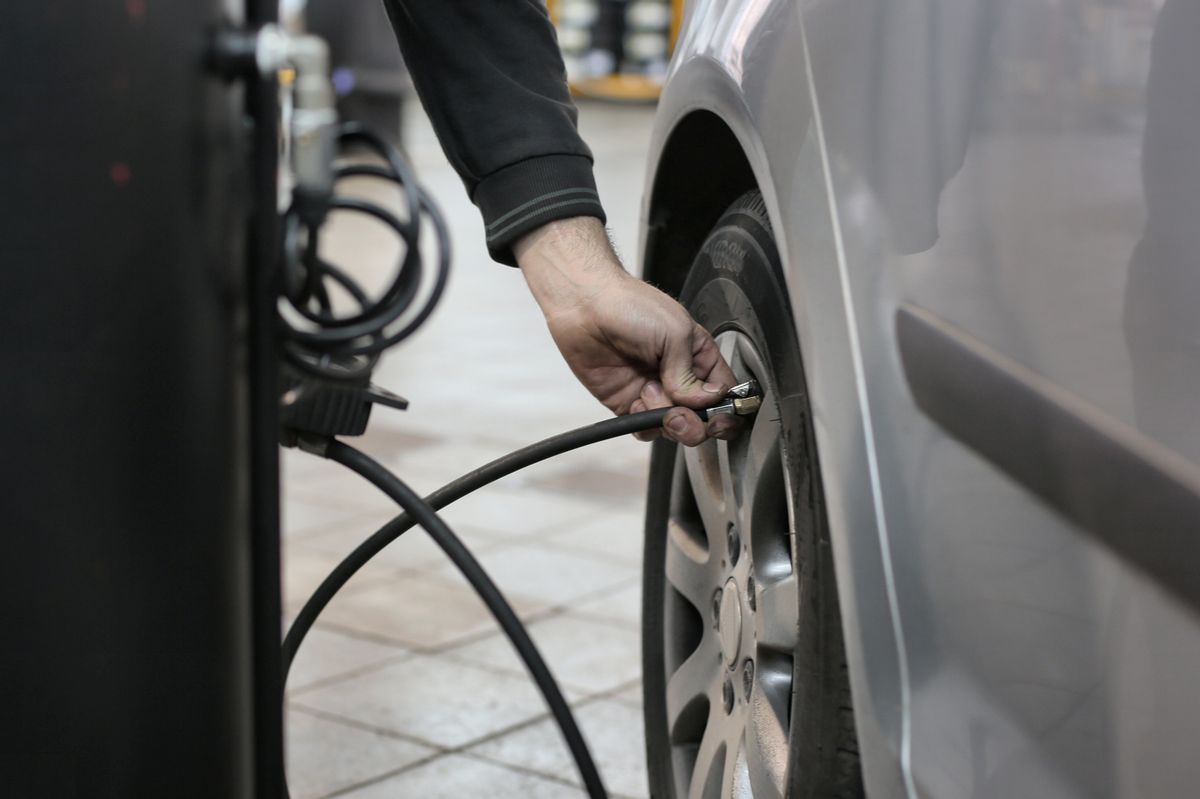
- Top up each tyre to the recommended figure. Use a forecourt air machine or a home inflator. Check all four, plus the spare if you have one.
- Refit the valve caps. They keep out the dirt, water and road salt that damage valves over winter.
- Reset the system if your car needs it. Cars with indirect TPMS have a reset button or a menu option. With direct TPMS, the light normally clears on its own after a few minutes of driving.
Should you put extra air in your tyres for winter?
No. The pressures your vehicle manufacturer recommends are cold pressures, and they apply all year round. The answer to cold weather is to check more often, so your tyres stay at the right figure as the temperature falls, and not to deliberately over-inflate them.
Over-inflated tyres have a smaller contact patch with the road. That means less grip and longer stopping distances, which is the last thing you want on wet, greasy winter roads. The one exception is if your handbook gives a specific figure for winter tyres or heavy loads, in which case follow the handbook.
It is also worth ignoring the old myth about letting air out for better grip in snow. On a modern road car this makes the handling less stable and can damage the tyre.
When the light means a real problem
Cold weather is the most common cause at this time of year, but it is not the only one. Book a proper inspection if you notice any of the following:
- The light returns within a few days of topping up. This usually points to a slow puncture, often a nail or screw in the tread.
- One tyre is much lower than the other three. Cold affects all four tyres roughly equally. A single low tyre is leaking.
- The light flashes for a minute or so and then stays on. On most cars this signals a fault with the TPMS itself, commonly a sensor whose battery has run out. Sensor batteries are sealed in and typically last between five and ten years.
- The steering pulls to one side or you feel a vibration. You may have pothole damage, a bulge in the sidewall or an alignment problem. Our guide to wheel alignment costs in the UK explains what is involved.
- The light stays on with correct pressures on all four tyres. The system may need recalibrating, or a sensor may have been damaged.
Winter is hard on the parts of a wheel that hold air in. Road salt corrodes alloy rims where the tyre seals against them, rubber valve stems harden and crack, and potholes hidden under standing water can pinch a sidewall. A leak that was too small to notice in summer often shows itself once the cold arrives.
If you drive on run-flat tyres, be especially careful, because they are built to hide the feel of a puncture. Our guide on how to identify run-flat tyres shows you how to check what is fitted to your car.

Is it safe to drive with the tyre pressure light on?
You can usually drive carefully to the nearest air machine or tyre centre, provided no tyre looks visibly flat. You should not ignore the light for days or weeks. Under-inflated tyres cause real problems:
- Longer braking distances and less grip, particularly in the wet.
- Vague, heavy steering and a greater risk of aquaplaning.
- Faster wear on the outer edges of the tread, which shortens tyre life.
- Higher fuel bills, because the engine works harder to turn a soft tyre.
- A greater risk of sudden tyre failure, especially at motorway speeds, because a soft tyre flexes and overheats.
There is a legal side too. The Highway Code requires tyres to be correctly inflated to the manufacturer's specification, and driving on a defective tyre can bring a fine of up to £2,500 and three penalty points for each tyre.
Will a tyre pressure light fail my MOT?
It can. On cars first used on or after 1 January 2012, the MOT includes a check that the TPMS warning lamp is working, and a lamp showing a system malfunction is recorded as a major defect, which is a fail. The government's list of car parts checked at an MOT confirms the TPMS check.
A light that is on simply because your tyres are low is easy to deal with: inflate them correctly before the test. A sensor fault needs fixing beforehand. If your test is coming up, see our guide on how to check your car's MOT status and expiry date.
Winter tyre pressure checklist
- Check all four tyres at least once a month and before any long journey.
- Check again after any sudden cold snap, since that is when pressures fall fastest.
- Always measure when the tyres are cold.
- While you are there, check tread depth. The legal minimum is 1.6mm, but grip in the wet falls away well before that, so plan to replace tyres at around 3mm.
- Look for cuts, bulges and anything stuck in the tread.
- Keep a decent pressure gauge in the glovebox. Forecourt gauges are not always accurate.
Frequently asked questions
How much does tyre pressure drop in cold weather?
Roughly 1 to 2 PSI for every 10°C fall in temperature. A tyre set to 32 PSI at 20°C will read about 29 PSI at freezing point.
Why is my tyre pressure light on when my tyres look fine?
A tyre can be 20 percent under-inflated and still look normal, especially a low-profile tyre with a stiff sidewall. Never judge by eye. Use a gauge.
Will the tyre pressure light go off by itself?
It often does once the tyres warm up, but the tyres are still under-inflated. Top them up to the correct cold pressure so the light stays off for the right reason.
How do I reset the tyre pressure light after adding air?
On many cars it clears after a few minutes of driving. Others need a reset through a dashboard button or the infotainment menu. Your handbook will tell you which applies. Only reset it after setting all four tyres to the correct pressure.
Can cold weather damage a TPMS sensor?
Cold does not damage a healthy sensor, but it can finish off one with a weak battery. If the light flashes before staying on, have the sensors checked.
Is nitrogen better than air for winter?
Nitrogen-filled tyres still lose pressure as the temperature falls. Normal air is already about 78 percent nitrogen, so for everyday driving, regular checks matter far more than what you fill with.
Light still on? Let Outens take a look
If your tyre pressure light keeps coming back, or you would like your tyres checked before winter sets in, our team at Outens Auto Centre in Grays, Essex can help. We deal with punctures, worn tyres and TPMS warnings every day.
Book a tyre fitting | Shop tyres by size or registration | Contact us or call 01708 865389
This guide is general advice. Always follow the tyre pressures and procedures given in your vehicle handbook.